

Skip to header Skip to main navigation Skip to main content Skip to footer

Search form

Site branding

Home
What's up, home?

Main navigation

  • Home
  • Story mode
  • About
  • Features
  • Hardware list
  • Videos
  • GitHub (opens in new tab)
  • Daily AI generated stories (opens in new tab)

Part 76: I installed a Zabbix proxy for What's up, home

Breadcrumbs

Breadcrumb

  • Home
  • Part 76: I installed a Zabbix proxy for What's up, home

Main page content

By whatsuphome | 10:02 PM EEST, Tue April 16, 2024

TL;DR

I installed a Zabbix 7.0 proxy on a remote FreeBSD virtual server to monitor this blog and other websites. The proxy runs in hybrid mode and I plan to subject it to simulated network issues like blackouts, packet loss, and delays to test Zabbix 7.0's new
Part 76 cover image

Recently I installed a Zabbix 7.0 proxy on a remote rental FreeBSD virtual server of mine. Why?

To give Zabbix 7.0 proxy some hard time

I do not envy my new proxy. If I would be a piece of software, I really would not want to be it. No, not because it would be challenging -- no, this one must be the most bored proxy of all time. It doesn't have too much to do, other than now it's testing this blog and few other websites instead of my home Raspberry Pi 4 doing that.

Proxy

But that does not mean that the proxy will have any smooth sailing in its horizon. For now, I'll let it run in peace, just to see that the 7.0 proxy itself is stable on FreeBSD. So far so good, it's been running for many days already without any issues.
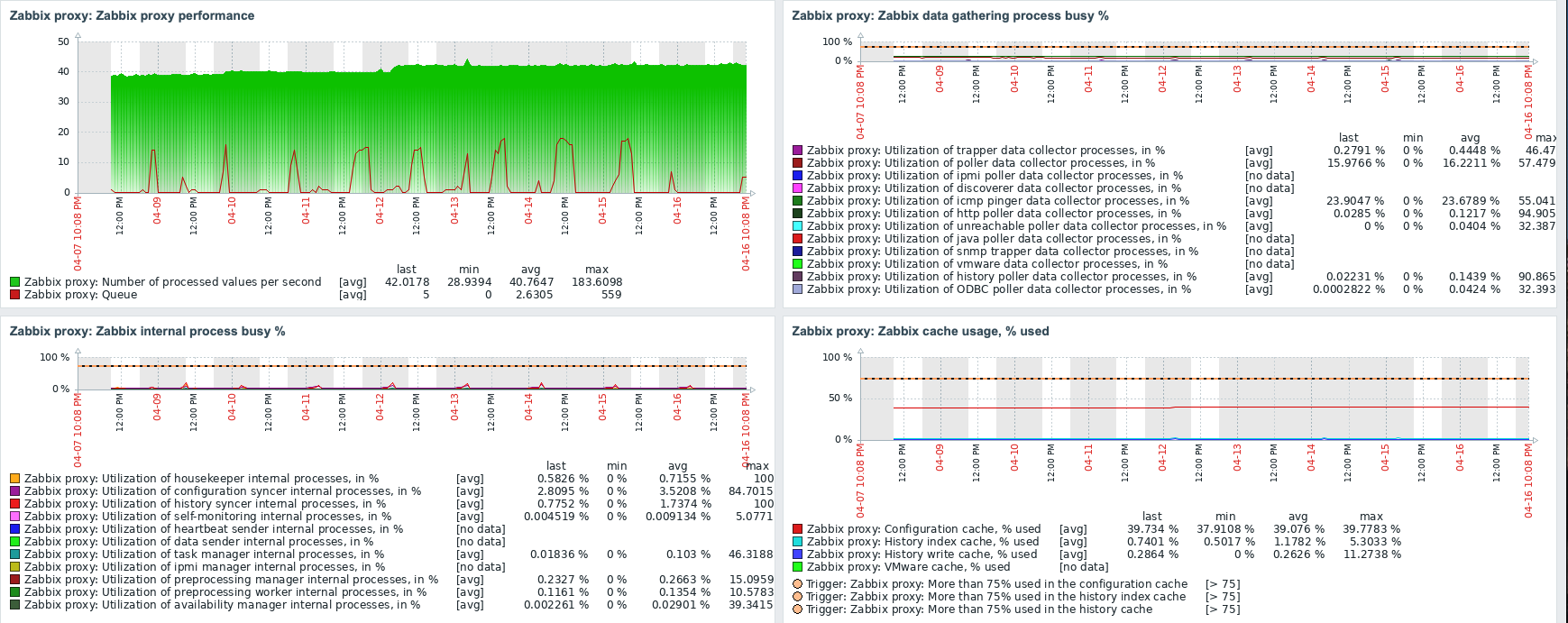
Proxy overview

In phase 2, beginning next week, I'll start to cause surprise issues for it, including but not limited to:

  • complete blackout between the proxy and my Zabbix server
  • random slowness in the network connection between the proxy and the server
  • random network delays in the network connectivity
  • random packet loss

To try out the new proxy memory/hybrid modes

As the new Zabbix 7.0 proxy comes with pure memory mode where it does not touch the disk at all, and with the hybrid mode that only uses disk if the specified RAM limits are not enough, of course that needs to be tested. For now my proxy runs in hybrid mode.

Because I can

What would my home monitoring kingdom be without at least one proxy? Less of a kingdom. That's why I also do have another proxy, but that's running on my nearby Linux laptop for monitoring the weird network I have dedicated for its virtual machines... that will be a story for another time.


Laptop proxy


whatsuphome
zabbix
proxy
freebsd
  • Allowed HTML tags: <a href hreflang> <em> <strong> <cite> <blockquote cite> <code> <ul type> <ol start type> <li> <dl> <dt> <dd> <h2 id> <h3 id> <h4 id> <h5 id> <h6 id>
  • Lines and paragraphs break automatically.
  • Web page addresses and email addresses turn into links automatically.
I installed a Zabbix 7.0 proxy on a remote FreeBSD virtual server to monitor this blog and other websites. The proxy runs in hybrid mode and I plan to subject it to simulated network issues like blackouts, packet loss, and delays to test Zabbix 7.0's new

Search

Who am I?

  • Janne Pikkarainen from Finland 🇫🇮
  • Began with computers in 1986 with C64
  • Doing IT for living since 1999
  • Principal Site Reliability Engineer at Forcepoint
  • A Zabbix Summit speaker every year since 2022
  • Walking, talking Zabbix commercial

Support my project

Buy me a coffee 

Footer menu

  • Contact

What's up, home? | Janne Pikkarainen | contact(at)whatsuphome.fi | 2022 - 2026

Developed and Designed by Janne Pikkarainen